Photo Michael Gäbler, CC BY 3.0, Wikimedia Commons
Old townKranjska Gora, Upper Carniola Region, Slovenia
Kranjska Gora and Jasna: what to see, map and route
Kranjska Gora and Lake Jasna. In the Turi app, the same map shows your position, guides you from point to point and lets you tick off the places you’ve visited.
free entrymuseums and towers have separate tickets
The walk starts at the tourist information office in the Vitranc hall on Kolodvorska ulica, a few minutes on foot from the bus stop in the centre. Buses run to Kranjska Gora from Ljubljana via Kranj and Jesenice; check the timetable with the operator or at the tourist information office. From the centre to Lake Jasna it is about 2 kilometres along an almost flat path, and you return the same way, so the whole route is about 5 kilometres. The museum in Liznjekova domačija is open from Tuesday to Sunday (closed on Mondays), and an adult ticket costs 2.50 euros; opening hours can vary, so check them before your visit. The church, the monuments, the path and the lake are free to visit. In winter Kranjska Gora is a ski resort: you can easily see the centre, the church and the monuments on foot, but the path to Jasna is sometimes covered with snow or icy, so wear shoes with a good sole and do not walk onto the ski runs or onto the frozen lake. It gets dark early in winter, so set off for the lake before noon. There is a toilet at the tourist information office in the centre, and otherwise in cafés and restaurants. Plan about 3 hours, including a visit to the museum.
At home, open the place in Turi and tap “Save for offline”: the map, descriptions and photos will work without signal.
Visit the farthest points first, while you still have energy.
Tick things off as you go, and by the exit you’ll know what’s left.
Kranjska Gora and Jasna in the Turi app
Live position, a route from point to point, descriptions to read and listen to. Free, no account, in 12 languages.
The same map as in the app. Tap a point to see its photo and description; in Turi you’ll see yourselves on it too.
1recommended, in route orderother pointsWCtoilets, food, tickets
Something not right? Report it in the app at that point.
Worth seeing
Kranjska Gora lies in the upper Sava Dolinka valley, beneath the peaks of the Julian Alps, and in winter it is one of the best-known ski resorts in Slovenia. The walk leads through the centre, where you will see the former railway station, the historic Liznjekova domačija farmstead with its museum, the late Gothic Church of the Assumption of the Blessed Virgin Mary and the statue of Kekec, the hero of Josip Vandot's stories. Then a forest path along the Pišnica stream takes you to Lake Jasna, about 2 kilometres from the centre. By the lake stands a statue of Zlatorog from the old legend, and from the viewing tower you can see the lake and the peaks of Prisojnik and Razor.
Photo Ajznponar, CC BY-SA 4.0, Wikimedia Commons1
Building / monument
The former railway station
Kolodvorska ulica, meaning Station Street, leads to the building of the former railway station. A railway line ran through Kranjska Gora from Ljubljana via Jesenice to Tarvisio in Italy, opened in 1870. In the late 1960s the section through Kranjska Gora was closed, and the station building was turned into apartments. Today a cycle path runs along the old railway track through the Sava Dolinka valley.
Photo Ajznponar, CC BY-SA 4.0, Wikimedia Commons2
muzeum
Liznjekova domačija
Liznjekova domačija is a historic farmstead more than 300 years old, standing on the old main road of the village. The house was built in the second half of the 17th century and rebuilt in the 18th century in the peasant baroque style, while the farm building dates from 1781. In the museum you will see a black kitchen, an entrance hall and a room with a wooden ceiling, painted chests and a clock from the 19th century. In the cellar there is a permanent exhibition about Josip Vandot, the author of the Kekec stories, who was born in Kranjska Gora. The museum is open from Tuesday to Sunday, and an adult ticket costs 2.50 euros.
Photo Tiia Monto, CC BY-SA 3.0, Wikimedia Commons3
Attraction
Borovška cesta
Borovška cesta is the old main road of the village, and Liznjekova domačija stands on it too. The stretch by the church is now a pedestrian street paved with cobblestones. Along the street there are still old houses with wooden balconies, and between them cafés, shops and hotels.
Photo Tiia Monto, CC BY-SA 3.0, Wikimedia Commons4
Building / monument
Church of the Assumption of the Blessed Virgin Mary
The parish Church of the Assumption of the Blessed Virgin Mary stands right in the middle of the old village. The present late Gothic church was built in 1510-1520, and the construction was led by master Jernej Firtaler of Villach (Beljak in Slovenian). A star vault decorates the chancel and the nave, and the paintings from around 1530-1540 are attributed to the painter Jernej of Loka. The Romanesque tower has survived from the earlier church.
Photo Žiga at Slovenian Wikipedia, Public domain, Wikimedia Commons5
widok
Kekec monument and view of Vitranc
Nearby, in a small park by the Hotel Kranjska Gora, stands a bronze statue of Kekec, the mountain boy from the stories of Josip Vandot (1884-1944), a writer born in Kranjska Gora; the 1951 film "Kekec" won an award at the Venice film festival. From here you can also see the ski slopes on the slopes of Vitranc. In winter the lifts and downhill runs operate here, and in nearby Podkoren the Vitranc Cup has been held since 1961, and since 1968 it has been part of the Alpine Ski World Cup. Do not walk onto the downhill runs while skiers are using them.
Photo Michael Gäbler, CC BY 3.0, Wikimedia Commons6
przyroda
Lake Jasna and Zlatorog
Jasna is a pair of connected artificial lakes, laid out for tourists where the Velika Pišnica and Mala Pišnica meet, at the start of the road to the Vršič pass. On the shore, on a rock, stands a bronze statue of Zlatorog, the white goat with golden horns from the old legend, the work of the sculptor Stojan Batič from 1986-1988. According to the legend, Zlatorog guarded the treasures beneath Triglav, and when a hunter shot him, flowers grew from his blood that healed him; enraged, he hurled the hunter into the abyss and destroyed his garden on the peaks. The legend was written down in 1868 by Karel Dežman, and in 1877 Rudolf Baumbach turned it into a poem. In summer people sunbathe on the shore and swim, although the water is very cold; in winter the lake often freezes, so do not walk onto the ice.
Photo Michael R Perry, CC BY 2.0, Wikimedia Commons7
Attraction
The little bridge over Jasna
A wooden bridge leads across the water between the shores of the lake. From its middle you can see the green, clear water and the forest reaching down to the shore, and on clear days the peaks reflected in the surface. Ducks often swim near the shore. In winter the planks may be icy, so walk carefully.
Photo J.O., CC BY-SA 4.0, Wikimedia Commons8
widok
The viewing tower above Jasna
There is a viewing tower by the lake: the old wooden tower from 2015 was taken down because it was in poor condition, and a new one was built in 2024. From the top you will see the whole surface of the lake and the Pišnica valley, above which rise Prisojnik and Razor, the peaks closing the valley to the south, towards the Vršič pass. It is a good spot for a photo of the lake with the mountains in the background.
All points (10)
Grouped as in the map legend. A star marks recommended points.
Building / monument 2
The former railway station ★Kolodvorska ulica, meaning Station Street, leads to the building of the former railway station. A railway line ran through Kranjska Gora from Ljubljana via Jesenice to Tarvisio in Italy, opened in 1870. In the late 1960s the section through Kranjska Gora was closed, and the station building was turned into apartments. Today a cycle path runs along the old railway track through the Sava Dolinka valley.
Church of the Assumption of the Blessed Virgin Mary ★The parish Church of the Assumption of the Blessed Virgin Mary stands right in the middle of the old village. The present late Gothic church was built in 1510-1520, and the construction was led by master Jernej Firtaler of Villach (Beljak in Slovenian). A star vault decorates the chancel and the nave, and the paintings from around 1530-1540 are attributed to the painter Jernej of Loka. The Romanesque tower has survived from the earlier church.
muzeum 1
Liznjekova domačija ★Liznjekova domačija is a historic farmstead more than 300 years old, standing on the old main road of the village. The house was built in the second half of the 17th century and rebuilt in the 18th century in the peasant baroque style, while the farm building dates from 1781. In the museum you will see a black kitchen, an entrance hall and a room with a wooden ceiling, painted chests and a clock from the 19th century. In the cellar there is a permanent exhibition about Josip Vandot, the author of the Kekec stories, who was born in Kranjska Gora. The museum is open from Tuesday to Sunday, and an adult ticket costs 2.50 euros.
Attraction 2
Borovška cesta ★Borovška cesta is the old main road of the village, and Liznjekova domačija stands on it too. The stretch by the church is now a pedestrian street paved with cobblestones. Along the street there are still old houses with wooden balconies, and between them cafés, shops and hotels.
The little bridge over Jasna ★A wooden bridge leads across the water between the shores of the lake. From its middle you can see the green, clear water and the forest reaching down to the shore, and on clear days the peaks reflected in the surface. Ducks often swim near the shore. In winter the planks may be icy, so walk carefully.
widok 2
Kekec monument and view of Vitranc ★Nearby, in a small park by the Hotel Kranjska Gora, stands a bronze statue of Kekec, the mountain boy from the stories of Josip Vandot (1884-1944), a writer born in Kranjska Gora; the 1951 film "Kekec" won an award at the Venice film festival. From here you can also see the ski slopes on the slopes of Vitranc. In winter the lifts and downhill runs operate here, and in nearby Podkoren the Vitranc Cup has been held since 1961, and since 1968 it has been part of the Alpine Ski World Cup. Do not walk onto the downhill runs while skiers are using them.
The viewing tower above Jasna ★There is a viewing tower by the lake: the old wooden tower from 2015 was taken down because it was in poor condition, and a new one was built in 2024. From the top you will see the whole surface of the lake and the Pišnica valley, above which rise Prisojnik and Razor, the peaks closing the valley to the south, towards the Vršič pass. It is a good spot for a photo of the lake with the mountains in the background.
przyroda 1
Lake Jasna and Zlatorog ★Jasna is a pair of connected artificial lakes, laid out for tourists where the Velika Pišnica and Mala Pišnica meet, at the start of the road to the Vršič pass. On the shore, on a rock, stands a bronze statue of Zlatorog, the white goat with golden horns from the old legend, the work of the sculptor Stojan Batič from 1986-1988. According to the legend, Zlatorog guarded the treasures beneath Triglav, and when a hunter shot him, flowers grew from his blood that healed him; enraged, he hurled the hunter into the abyss and destroyed his garden on the peaks. The legend was written down in 1868 by Karel Dežman, and in 1877 Rudolf Baumbach turned it into a poem. In summer people sunbathe on the shore and swim, although the water is very cold; in winter the lake often freezes, so do not walk onto the ice.
Toilets / tickets / parking 2
Start at the tourist information officeThe walk starts at the tourist information office in the Vitranc hall on Kolodvorska ulica, a few minutes on foot from the bus stop in the centre. Kranjska Gora lies in the upper Sava Dolinka valley, beneath the Julian Alps, a few kilometres from the border with Austria and Italy. In winter it is one of the best-known ski resorts in Slovenia, and in summer a base for trips into the mountains and to the Vršič pass. First you will see the centre with the former railway station, the old farmstead and the Gothic church, and then you will follow the path along the Pišnica stream to Lake Jasna, about 2 kilometres from the centre.

 Photo Michael Gäbler, CC BY 3.0, Wikimedia Commons

 Photo Ajznponar, CC BY-SA 4.0, Wikimedia Commons1
 Photo Ajznponar, CC BY-SA 4.0, Wikimedia Commons
 Photo Tiia Monto, CC BY-SA 3.0, Wikimedia Commons
 Photo Tiia Monto, CC BY-SA 3.0, Wikimedia Commons
 Photo Žiga at Slovenian Wikipedia, Public domain, Wikimedia Commons
 Photo Michael R Perry, CC BY 2.0, Wikimedia Commons
 Photo J.O., CC BY-SA 4.0, Wikimedia Commons
 Photo Abrget47j, CC BY-SA 3.0, Wikimedia Commons
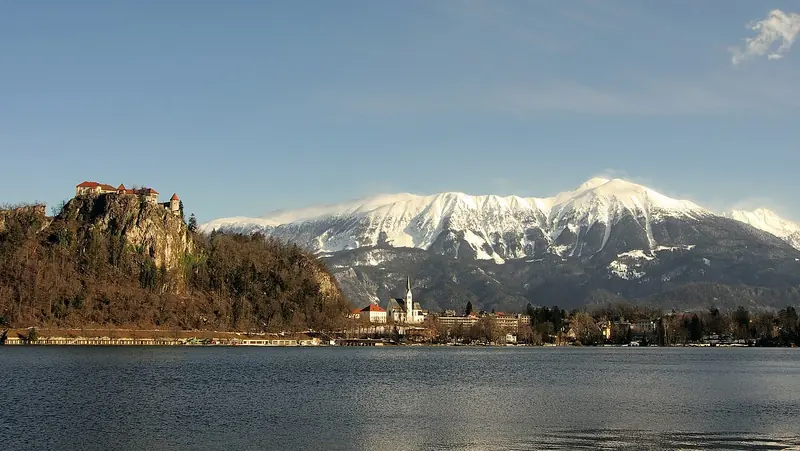 Photo Simon Wa, CC BY 2.0, Wikimedia Commons
 Photo Zairon, CC BY-SA 4.0, Wikimedia Commons