Tierpark Hagenbeck with children: what to see, map and route
Tierpark Hagenbeck in Hamburg. In the Turi app, the same map shows your position, guides you from point to point and lets you tick off the places you’ve visited.
The walk starts and ends at the main entrance with the Nepalese pagoda on Lokstedter Grenzstraße, next to the U2 underground station Hagenbecks Tierpark; buses 22, X22, 181, 281, 391 and 392 also serve the stop of the same name. Admission is charged: an adult ticket costs 29 euros, a ticket for children aged 4 to 16 costs 19 euros, and the Tropen-Aquarium by the entrance is a separate paid extra for 25 euros, or a combined ticket with the park for 45 euros. The park is open daily from 9:00, from March to 24 October until 18:00, and in winter, from 25 October to the end of February, only until 16:30; the ticket offices close an hour earlier, and entry to Eismeer closes half an hour before the park closes. The Tropen-Aquarium is open all year round from 9:00 to 18:00. From November to March, the side entrance on Gazellenkamp is closed, the Flamingo Lodge restaurant takes a winter break and the restaurant by the playground is open instead; many public feedings take place only from March to October, and the Kamchatka bears rest from November to February. Most paths are accessible for wheelchairs and pushchairs, and there are lifts in Eismeer. You will find toilets at the main entrance, in Eismeer, by the Flamingo Lodge restaurant, by the playground restaurant and by the orangutan house. Dogs are not allowed in. If you are already in the park, Turi will guide you from the nearest point. Allow about 3 hours, not counting the Tropen-Aquarium.
At home, open the place in Turi and tap “Save for offline”: the map, descriptions and photos will work without signal.
Visit the farthest points first, while you still have energy.
Tick things off as you go, and by the exit you’ll know what’s left.
Tierpark Hagenbeck in the Turi app
Live position, a route from point to point, descriptions to read and listen to. Free, no account, in 12 languages.
The same map as in the app. Tap a point to see its photo and description; in Turi you’ll see yourselves on it too.
1recommended, in route orderother pointsWCtoilets, food, tickets
Something not right? Report it in the app at that point.
Worth seeing
Tierpark Hagenbeck was opened by Carl Hagenbeck on 7 May 1907 in the Stellingen district as the world's first zoo without bars: here, hidden moats separate the animals from people, and Hagenbeck had already patented the idea of such enclosures in 1896. In 1943, bombing destroyed about 70 per cent of the park, and the Hagenbeck family rebuilt it at their own expense. In 1997, the park was added to Hamburg's list of heritage monuments. On 19 hectares with about 1000 trees, more than 1400 animals of about 140 species live here today, from Asian elephants to the only group of walruses in Germany.
Photo LadyofHats, Public domain, Wikimedia Commons1
Animals
Tapirs and capybaras
Just past the entrance, next to the Märchenland fairy-tale corner, live lowland tapirs and capybaras. They share a 1000 square metre enclosure, which the capybara Ramon and the female tapir Yamari moved into. The public tapir feeding takes place daily at 14:30 all year round, including in winter.
Photo Kandukuru Nagarjun from Bangalore, India, CC BY 2.0, Wikimedia Commons2
Animals
Kamchatka bears
Next to the old gate live Kamchatka bears, named after the Kamchatka Peninsula in the far east of Russia. In January 2011, 2 cubs were born here. From March to October there is a public feeding daily at 14:15, and from November to February the bears rest, so in winter you may not see them.
Photo H. Zell, CC BY-SA 3.0, Wikimedia Commons3
Building / monument
Art Nouveau gate
This Art Nouveau gate was the main entrance to the park from its opening in 1907, and at that time it still stood in an empty field. It was designed by the theatre architect Moritz Lehmann, and the animal figures were modelled by Josef Pallenberg, who also made the park's dinosaurs. After the entrance was moved in 2003, the gate no longer served as an entrance and fell into disrepair: in 2022 its bronze figures were removed, and in May 2025 it was dismantled completely. In August 2026, after about 15 months of construction, a faithful replica of the former entrance was opened, and you can walk through it again.
Photo Joergsam, CC BY-SA 4.0, Wikimedia Commons4
Attraction
Carl Hagenbeck monument
Carl Hagenbeck (1844-1913) took over the family animal trading business at the age of 21, and in 1907 he opened this park. His sons Heinrich and Lorenz put up this monument to him in 1926. Here Hagenbeck stands with his favourite lion Triest, with whom he shared an exceptionally close bond. Hagenbeck also developed gentle training, based on rewarding animals instead of punishing them.
Photo Cavernia, CC BY-SA 4.0, Wikimedia Commons5
Animals
African steppe
On the African steppe, Chapman's zebras, ostriches and warthogs live together in one enclosure, as on the savannah. At the beginning of the twentieth century, such shared enclosures instead of single-species cages were a novelty that became a model for zoos all over the world. Hagenbeck chose the width of the moats according to how high and how far the animals jump, which he knew from his work in the circus.
Photo H. Zell, CC BY-SA 3.0, Wikimedia Commons6
Attraction
African Panorama
From here you see Hagenbeck's most famous view: from the flamingo pond across the steppe to the artificial rocks in the background, and it all looks like a single landscape, although the animals are separated by invisible moats. The rocks were built under the direction of Urs Eggenschwyler, first as a wooden frame covered with concrete; today they have a steel and concrete structure. Barbary sheep climb about on the rocks. The historic pond has been restored, and in July 2026 Cuban and Chilean flamingos returned to it.
Photo Cavernia, CC BY-SA 4.0, Wikimedia Commons7
Animals
Polar bears
This is where Eismeer, meaning the Ice Sea, begins. It opened in July 2012 at a cost of about 21 million euros, on the site of the Northern Panorama from 1907. Across more than 8000 square metres, a polar landscape with 1200 square metres of water has been created, and through large windows you can see the animals underwater too. In December 2022, the first polar bear in Eismeer was born here, and in March 2026 the male Rasputin arrived from Aalborg. An adult male polar bear can weigh as much as 600 kilograms.
Photo dicau58, CC BY-SA 2.0, Wikimedia Commons8
Animals
Walruses
Hagenbeck has the only group of Pacific walruses in Germany. In June 2014, Thor was born here, the first walrus born in Germany. Walruses weigh from 800 to 1900 kilograms, and both males and females have tusks; these help them haul themselves onto ice and rocks. The public feeding is daily at 15:00 all year round, and from November to February fur seals are sometimes fed instead of the walruses. In Eismeer, take photos without flash, as some of the animals are sensitive to light.
Photo LadyofHats, Public domain, Wikimedia Commons9
Animals
Penguins
In the chilled part of Eismeer, where the temperature is 7 degrees, live king penguins and gentoo penguins. Next door, outside, you will also see Humboldt penguins. You can walk into the aviary with seabirds from the far north, including eider ducks and Arctic terns. The whole path through Eismeer is 750 metres long.
Photo H. Zell, CC BY-SA 3.0, Wikimedia Commons10
Attraction
Japanese Island
The red lacquered temple gates and the little bridge between them are one of the favourite photo spots in the park. On the Japanese Island you will see genuine Japanese bronzes, and water birds and turtles swim in the ponds. In summer, pink flamingos wade right next to it. Stop on the bridge and look out over the Japanese Pond.
Photo 肖诗白(Xiao Shibai) and 猫盟(Chinese Felid Conservation…, Attribution, Wikimedia Commons11
Animals
North Chinese leopards
The North Chinese leopards live in a new, enlarged enclosure. Hagenbeck coordinates the European breeding programme for this species. At the beginning of August 2026, 3 cubs were born here, and in October they were shown to visitors for the first time; they were named Suko, Kenji and Chen Lu. Snowy owls live next door.
Photo Aiwok, CC BY-SA 3.0, Wikimedia Commons12
Animals
Siberian tigers
The Tiger Path runs along the enclosure of the Siberian tigers, the largest of all tigers. Males weigh from 210 to 300 kilograms and hunt red deer, roe deer and elk. In the wild, in the far east of Russia, about 500 of them live, and in the 1930s probably no more than 50 were left. Hagenbeck takes part in the European breeding programme, and in 2022, 2 tiger cubs were born here.
Photo H. Zell, CC BY-SA 3.0, Wikimedia Commons13
Attraction
Dinosaurs and giant tortoises
Among the trees stand life-size dinosaur figures, made from models by the sculptor Josef Pallenberg. There are 12 of them, from diplodocus through triceratops to stegosaurus; they have stood here since 1909, and after more than 100 years of rain and frost they need restoring, so at some of them you may come across conservation work. Giant tortoises live next to them.
Photo H. Zell, CC BY-SA 3.0, Wikimedia Commons14
Building / monument
Thai Sala by the Burmese Pond
The gilded, handmade pavilion by the Burmese Pond is a gift from the honorary consul Wolfgang Krohn. At the end of August 2002 it was opened by the Thai princess Maha Chakri Sirindhorn. In her words, the Sala is meant to be a place of peace where the friendship between Hamburg and Thailand lives on, so sit down here for a moment and look at the water.
Photo H. Zell, CC BY-SA 3.0, Wikimedia Commons15
Animals
Sumatran orangutans
The orangutan house opened in 2004; it is covered by a transparent dome 32 metres in diameter and 16 metres high, which can be opened halfway on warm days. The Sumatran orangutans have 350 square metres here and climb up to a height of 13 metres, and they share their enclosure with Asian small-clawed otters. In 2020, 2 baby orangutans were born here. The public feeding is daily at 13:30 all year round, and there are toilets by the orangutan house.
Photo H. Zell, CC BY-SA 3.0, Wikimedia Commons16
Animals
Asian elephants
Hagenbeck has one of the largest herds of Asian elephants in Europe. Since the 1990s, 15 calves have been born here, and Kandy, born in May 2003, was the first elephant in Germany to be born in the middle of the herd. In 1943, after the bombing, the elephants helped to clear rubble in the park. Since 2025 the enclosure has been growing, eventually to about 11,200 square metres, and from March to October at 14:00 you can watch a public feeding.
All points (24)
Grouped as in the map legend. A star marks recommended points.
Animals 10
Tapirs and capybaras ★Just past the entrance, next to the Märchenland fairy-tale corner, live lowland tapirs and capybaras. They share a 1000 square metre enclosure, which the capybara Ramon and the female tapir Yamari moved into. The public tapir feeding takes place daily at 14:30 all year round, including in winter.
Kamchatka bears ★Next to the old gate live Kamchatka bears, named after the Kamchatka Peninsula in the far east of Russia. In January 2011, 2 cubs were born here. From March to October there is a public feeding daily at 14:15, and from November to February the bears rest, so in winter you may not see them.
African steppe ★On the African steppe, Chapman's zebras, ostriches and warthogs live together in one enclosure, as on the savannah. At the beginning of the twentieth century, such shared enclosures instead of single-species cages were a novelty that became a model for zoos all over the world. Hagenbeck chose the width of the moats according to how high and how far the animals jump, which he knew from his work in the circus.
Polar bears ★This is where Eismeer, meaning the Ice Sea, begins. It opened in July 2012 at a cost of about 21 million euros, on the site of the Northern Panorama from 1907. Across more than 8000 square metres, a polar landscape with 1200 square metres of water has been created, and through large windows you can see the animals underwater too. In December 2022, the first polar bear in Eismeer was born here, and in March 2026 the male Rasputin arrived from Aalborg. An adult male polar bear can weigh as much as 600 kilograms.
Walruses ★Hagenbeck has the only group of Pacific walruses in Germany. In June 2014, Thor was born here, the first walrus born in Germany. Walruses weigh from 800 to 1900 kilograms, and both males and females have tusks; these help them haul themselves onto ice and rocks. The public feeding is daily at 15:00 all year round, and from November to February fur seals are sometimes fed instead of the walruses. In Eismeer, take photos without flash, as some of the animals are sensitive to light.
Penguins ★In the chilled part of Eismeer, where the temperature is 7 degrees, live king penguins and gentoo penguins. Next door, outside, you will also see Humboldt penguins. You can walk into the aviary with seabirds from the far north, including eider ducks and Arctic terns. The whole path through Eismeer is 750 metres long.
North Chinese leopards ★The North Chinese leopards live in a new, enlarged enclosure. Hagenbeck coordinates the European breeding programme for this species. At the beginning of August 2026, 3 cubs were born here, and in October they were shown to visitors for the first time; they were named Suko, Kenji and Chen Lu. Snowy owls live next door.
Siberian tigers ★The Tiger Path runs along the enclosure of the Siberian tigers, the largest of all tigers. Males weigh from 210 to 300 kilograms and hunt red deer, roe deer and elk. In the wild, in the far east of Russia, about 500 of them live, and in the 1930s probably no more than 50 were left. Hagenbeck takes part in the European breeding programme, and in 2022, 2 tiger cubs were born here.
Sumatran orangutans ★The orangutan house opened in 2004; it is covered by a transparent dome 32 metres in diameter and 16 metres high, which can be opened halfway on warm days. The Sumatran orangutans have 350 square metres here and climb up to a height of 13 metres, and they share their enclosure with Asian small-clawed otters. In 2020, 2 baby orangutans were born here. The public feeding is daily at 13:30 all year round, and there are toilets by the orangutan house.
Asian elephants ★Hagenbeck has one of the largest herds of Asian elephants in Europe. Since the 1990s, 15 calves have been born here, and Kandy, born in May 2003, was the first elephant in Germany to be born in the middle of the herd. In 1943, after the bombing, the elephants helped to clear rubble in the park. Since 2025 the enclosure has been growing, eventually to about 11,200 square metres, and from March to October at 14:00 you can watch a public feeding.
Building / monument 3
Art Nouveau gate ★This Art Nouveau gate was the main entrance to the park from its opening in 1907, and at that time it still stood in an empty field. It was designed by the theatre architect Moritz Lehmann, and the animal figures were modelled by Josef Pallenberg, who also made the park's dinosaurs. After the entrance was moved in 2003, the gate no longer served as an entrance and fell into disrepair: in 2022 its bronze figures were removed, and in May 2025 it was dismantled completely. In August 2026, after about 15 months of construction, a faithful replica of the former entrance was opened, and you can walk through it again.
Thai Sala by the Burmese Pond ★The gilded, handmade pavilion by the Burmese Pond is a gift from the honorary consul Wolfgang Krohn. At the end of August 2002 it was opened by the Thai princess Maha Chakri Sirindhorn. In her words, the Sala is meant to be a place of peace where the friendship between Hamburg and Thailand lives on, so sit down here for a moment and look at the water.
Tropen-AquariumThe Tropen-Aquarium opened in May 2007, for the park's 100th birthday. It covers about 8000 square metres and is the largest aquarium in Germany dedicated to the tropics: you will walk through the tropical world, the cave world, the venomous snake village and the underwater world. About 14,300 animals of more than 300 species live here, and through a curved window 14 metres long and 6 metres high you can look into the shark atoll. It is a paid extra for 25 euros, open all year round from 9:00 to 18:00, and pushchairs must be left at the entrance.
Attraction 4
Carl Hagenbeck monument ★Carl Hagenbeck (1844-1913) took over the family animal trading business at the age of 21, and in 1907 he opened this park. His sons Heinrich and Lorenz put up this monument to him in 1926. Here Hagenbeck stands with his favourite lion Triest, with whom he shared an exceptionally close bond. Hagenbeck also developed gentle training, based on rewarding animals instead of punishing them.
African Panorama ★From here you see Hagenbeck's most famous view: from the flamingo pond across the steppe to the artificial rocks in the background, and it all looks like a single landscape, although the animals are separated by invisible moats. The rocks were built under the direction of Urs Eggenschwyler, first as a wooden frame covered with concrete; today they have a steel and concrete structure. Barbary sheep climb about on the rocks. The historic pond has been restored, and in July 2026 Cuban and Chilean flamingos returned to it.
Japanese Island ★The red lacquered temple gates and the little bridge between them are one of the favourite photo spots in the park. On the Japanese Island you will see genuine Japanese bronzes, and water birds and turtles swim in the ponds. In summer, pink flamingos wade right next to it. Stop on the bridge and look out over the Japanese Pond.
Dinosaurs and giant tortoises ★Among the trees stand life-size dinosaur figures, made from models by the sculptor Josef Pallenberg. There are 12 of them, from diplodocus through triceratops to stegosaurus; they have stood here since 1909, and after more than 100 years of rain and frost they need restoring, so at some of them you may come across conservation work. Giant tortoises live next to them.
Toilets / tickets / parking 7
Public toilet
Public toilet
Public toilet
Public toilet
Public toilet
Public toilet
Main entrance with the Nepalese pagodaThe walk starts at the main entrance on Lokstedter Grenzstraße. Since spring 2003 it has been decorated by a Nepalese temple in the shape of a pagoda, hand-carved over about 2 years; in the same year, the main entrance was moved here from the old Art Nouveau gate. The pagoda houses a visitor service point, with toilets next to it. The route leads west past the old gate and the African Panorama to Eismeer, then north, and returns along the eastern side of the park past the tigers, orangutans and elephants.

 Photo An-d, CC BY-SA 3.0, Wikimedia Commons

 Photo LadyofHats, Public domain, Wikimedia Commons1
 Photo Kandukuru Nagarjun from Bangalore, India, CC BY 2.0, Wikimedia Commons
 Photo H. Zell, CC BY-SA 3.0, Wikimedia Commons
 Photo Joergsam, CC BY-SA 4.0, Wikimedia Commons
 Photo Cavernia, CC BY-SA 4.0, Wikimedia Commons
 Photo H. Zell, CC BY-SA 3.0, Wikimedia Commons
 Photo Cavernia, CC BY-SA 4.0, Wikimedia Commons
 Photo dicau58, CC BY-SA 2.0, Wikimedia Commons
 Photo LadyofHats, Public domain, Wikimedia Commons
 Photo H. Zell, CC BY-SA 3.0, Wikimedia Commons
 Photo 肖诗白(Xiao Shibai) and 猫盟(Chinese Felid Conservation…, Attribution, Wikimedia Commons
 Photo Aiwok, CC BY-SA 3.0, Wikimedia Commons
 Photo H. Zell, CC BY-SA 3.0, Wikimedia Commons
 Photo H. Zell, CC BY-SA 3.0, Wikimedia Commons
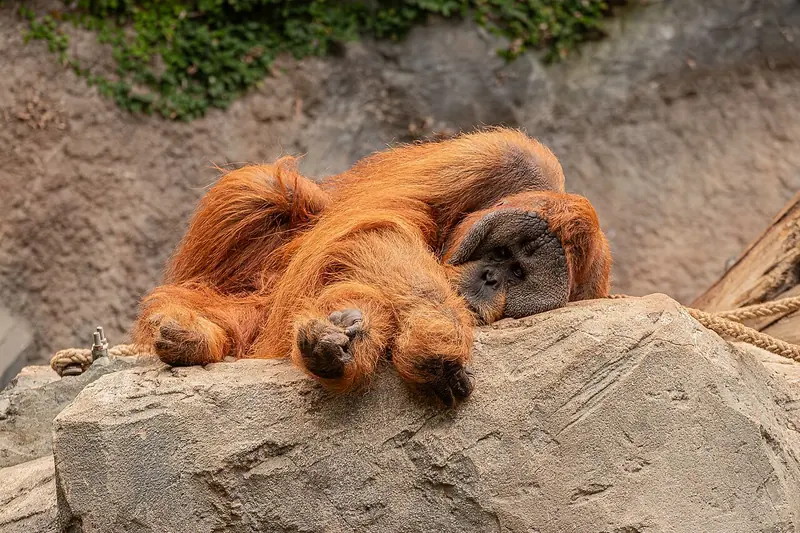 Photo H. Zell, CC BY-SA 3.0, Wikimedia Commons
 Photo H. Zell, CC BY-SA 3.0, Wikimedia Commons
 Photo -- Nightflyer ( talk ) 12:35, 30 August 2016 (UTC), CC BY 4.0, Wikimedia Commons
 Photo Christian Wolf ( www.c-w-design.de ), CC BY-SA 3.0 de, Wikimedia Commons
 Photo Carsten Steger, CC BY-SA 4.0, Wikimedia Commons