Photo Sergej Smirnov, CC BY 3.0, Wikimedia Commons
CastleSigulda, Sigulda Municipality, Latvia
Sigulda: castle ruins, the New Castle and views of the Gauja Valley: what to see, map and route
Sigulda: castle ruins, the New Castle and views of the Gauja Valley. In the Turi app, the same map shows your position, guides you from point to point and lets you tick off the places you’ve visited.
You can get to Sigulda from Riga by ViVi train or by bus. The train from Riga takes about 1 hour 8 minutes, and a ticket costs 2.80 euros. Trains run every 1-2 hours. Buses on line 6255 from Riga (Rīgas SAO station) cost 2.80 euros, and according to the timetables the journey takes from about 1 hour 10 minutes to 1 hour 30 minutes, depending on the departure and the route. The walk starts on Pils iela at the Keys Square and ends at the Ferris wheel and the terrace on Svētku laukums (Festival Square), from where you walk back to the centre. According to travellers' reviews, the castle is about 15-20 minutes on foot from the railway station (about 1 km along Pils iela). If you are already in Sigulda, Turi will guide you from the nearest point. In winter (Nov-Mar) the castle ruins are open daily from 9:00 to 17:00, and the New Castle is also open daily from 9:00 to 17:00. Tickets are sold until 30 minutes before closing, that is, until about 16:30. The ruins and the New Castle are paid: a combined ticket costs 4.50 euros for adults and 3.50 euros for school pupils, students and seniors. A ticket to the ruins alone costs 2.50 euros for adults, 2.00 euros for school pupils, students and seniors, and 5.00 euros for a family (2 adults and at least 2 children under 15). The New Castle alone: 3.50 euros for adults, 3.00 euros for school pupils, students and seniors, and 7.50 euros for a family. Children under 7 enter free of charge, as do orphans and people with disability group I or II. The New Castle tower is temporarily closed for technical reasons (since 20.05.2026, notice of 12.04.2026), and there is no information about when it will reopen, so it may still be closed. The Ferris wheel, the bungee jump and Zērglis are also paid, and their prices and winter hours have not been confirmed. The Sigulda tourism website gives the Ferris wheel's summer season as May to October (Mon-Fri 10:00-18:00, Sat-Sun 10:00-19:00), and there are no winter hours for the wheel. Check the current hours and prices before you go, as the official websites are not up to date. The route slopes gently down towards the valley and has steps at the ruins. Allow about two and a half hours, not counting the bungee jump.
At home, open the place in Turi and tap “Save for offline”: the map, descriptions and photos will work without signal.
Visit the farthest points first, while you still have energy.
Tick things off as you go, and by the exit you’ll know what’s left.
Sigulda: castles in the Turi app
Live position, a route from point to point, descriptions to read and listen to. Free, no account, in 12 languages.
The same map as in the app. Tap a point to see its photo and description; in Turi you’ll see yourselves on it too.
1recommended, in route orderother pointsWCtoilets, food, tickets
Something not right? Report it in the app at that point.
Worth seeing
Sigulda Castle was built between 1207 and 1209 by Master Venno of the Livonian Brothers of the Sword. During the Great Northern War the castle was destroyed and never rebuilt. Next to it stands the neo-Gothic New Castle, built from 1878 as the home of the Kropotkin princes, who owned the estate. An open-air stage has been set up in the ruins, where the Opera Music Festival and star concerts take place. The walk follows Pils iela from the Keys Square past the monuments and the church to the castles, then on to the edge of the Gauja Valley, to the bungee jump and the Ferris wheel. Near Sigulda the Gauja Valley reaches its greatest depth, 85 metres.
Photo Kenny McFly, CC BY-SA 3.0, Wikimedia Commons1
Attraction
Parade of Knights (Bruņinieku parāde)
The sculptures were created in 2010 at the art workshop Viduslaiku dzelzgriezējs (loosely translated, "Medieval Blacksmith"), in which six Latvian metal artists took part under the direction of Prof. Juris Gagainis of the Art Academy of Latvia. The knights are made from scrap metal, granite boulders and wooden elements. The group has fifteen figures and was created in 2010. It is good fun for children: count the knights and see what their helmets are made of.
Photo Sergej Smirnov, CC BY 3.0, Wikimedia Commons2
Building / monument
New Castle (Siguldas Jaunā pils)
The neo-Gothic New Castle was built in 1878-1881, in the time of Olga Kropotkina. The construction was led by master Jānis Meņģelis from Cēsis. Princess Olga arranged for the Riga-Pskov railway line to run through the town, and a health resort grew up. In 1922 the palace became home to the union of Latvian writers and journalists, hence the name Writers' Palace, and in Soviet times it housed a cardiology sanatorium. Since 1993 the palace has been the seat of the Sigulda municipality, and the building has an exhibition on the history of the castle.
Photo Voll, CC BY-SA 4.0, Wikimedia Commons3
Attraction
Ruins of the castle of the Livonian Brothers of the Sword
The castle was built in 1207-1209 on the orders of Master Venno, to control the Gauja waterways and to defend against the bishop's castle in Turaida, on the other side of the river. From 1432 the Land Marshal of the Livonian Order lived here, the second-ranking official of the Order after the Master. Since 2012 you can climb the north tower and the gate tower and walk along the walls.
Photo Voll, CC BY-SA 4.0, Wikimedia Commons4
Attraction
Stage in the castle ruins
An open-air stage has been set up in the ruins, where world-famous artists perform. The International Opera Music Festival takes place here at the end of July or the beginning of August. The main attraction of the festival is an original open-air opera, prepared specially for this stage. The audience has a picturesque view of the Gauja Valley in front of them.
Photo Aldis Dzenovskis, CC BY-SA 3.0, Wikimedia Commons5
widok
Viewing terrace over the Gauja Valley
At this spot there is an information board about the Gauja Valley (Gaujas senleja). The valley took its present shape after the last ice age, when meltwater from the glaciers carved out ancient gorges. Near Sigulda it is 85 metres deep and has no equal in the whole of the Baltic states. From another point in the castle ruins you can clearly see the castle in Turaida, so glance across to the opposite bank too.
All points (9)
Grouped as in the map legend. A star marks recommended points.
Attraction 3
Parade of Knights (Bruņinieku parāde) ★The sculptures were created in 2010 at the art workshop Viduslaiku dzelzgriezējs (loosely translated, "Medieval Blacksmith"), in which six Latvian metal artists took part under the direction of Prof. Juris Gagainis of the Art Academy of Latvia. The knights are made from scrap metal, granite boulders and wooden elements. The group has fifteen figures and was created in 2010. It is good fun for children: count the knights and see what their helmets are made of.
Ruins of the castle of the Livonian Brothers of the Sword ★The castle was built in 1207-1209 on the orders of Master Venno, to control the Gauja waterways and to defend against the bishop's castle in Turaida, on the other side of the river. From 1432 the Land Marshal of the Livonian Order lived here, the second-ranking official of the Order after the Master. Since 2012 you can climb the north tower and the gate tower and walk along the walls.
Stage in the castle ruins ★An open-air stage has been set up in the ruins, where world-famous artists perform. The International Opera Music Festival takes place here at the end of July or the beginning of August. The main attraction of the festival is an original open-air opera, prepared specially for this stage. The audience has a picturesque view of the Gauja Valley in front of them.
Building / monument 1
New Castle (Siguldas Jaunā pils) ★The neo-Gothic New Castle was built in 1878-1881, in the time of Olga Kropotkina. The construction was led by master Jānis Meņģelis from Cēsis. Princess Olga arranged for the Riga-Pskov railway line to run through the town, and a health resort grew up. In 1922 the palace became home to the union of Latvian writers and journalists, hence the name Writers' Palace, and in Soviet times it housed a cardiology sanatorium. Since 1993 the palace has been the seat of the Sigulda municipality, and the building has an exhibition on the history of the castle.
widok 1
Viewing terrace over the Gauja Valley ★At this spot there is an information board about the Gauja Valley (Gaujas senleja). The valley took its present shape after the last ice age, when meltwater from the glaciers carved out ancient gorges. Near Sigulda it is 85 metres deep and has no equal in the whole of the Baltic states. From another point in the castle ruins you can clearly see the castle in Turaida, so glance across to the opposite bank too.
Toilets / tickets / parking 4
Keys Square on Pils ielaThe walk begins on Pils iela, at a small square with three huge iron keys leaning against a stone wall. The keys symbolise the three historic centres of the valley: Sigulda, Turaida and Krimulda, and their unity. The square was opened in 2007 for the 800th anniversary of Sigulda. From here you walk north along the street, past the monument to Baron and the church, to the palace and the ruins. You finish at the viewing terrace on Svētku laukums.

 Photo Sergej Smirnov, CC BY 3.0, Wikimedia Commons

 Photo Kenny McFly, CC BY-SA 3.0, Wikimedia Commons1
 Photo Voll, CC BY-SA 4.0, Wikimedia Commons
 Photo Aldis Dzenovskis, CC BY-SA 3.0, Wikimedia Commons
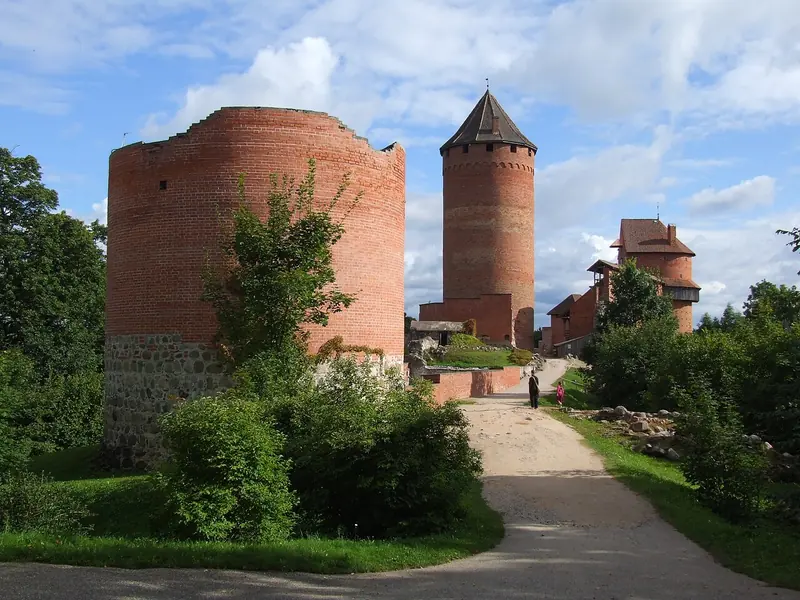 Photo Pudelek (Marcin Szala), CC BY-SA 3.0, Wikimedia Commons
 Photo Laima Gūtmane (simka…, CC BY-SA 3.0, Wikimedia Commons
 Photo Diego Delso, CC BY-SA 3.0, Wikimedia Commons