Photo Matthias Süßen, CC BY-SA 4.0, Wikimedia Commons
ZooSalzburg, Austria

Zoo Salzburg with children: what to see, map and route

Zoo Salzburg Hellbrunn. In the Turi app, the same map shows your position, guides you from point to point and lets you tick off the places you’ve visited.

18points to see
16on the recommended route
approx. 3 hvisiting with children

Before you go

approx. 3 hat an easy pace, with breaks
4toilets on the map
foodfood places are not on the map yet
The route starts at the main ticket office (Hauptkassa). Bus number 25 from Salzburg Hauptbahnhof station takes you to the Anif Zoo Salzburg stop, a 3 minute walk from the entrance, and the large zoo car park is free for visitors. First you walk north along the main avenue to the ibex by the Steinbock ticket office, where there is a passage to the Hellbrunn Palace park, closed outside the zoo's opening hours. Then you head back through Eurasia and South America to Africa, and the route ends at the cheetahs, from where the main avenue takes you back to the exit. If you are already in the zoo, Turi will guide you from the nearest point. Admission is charged, and a dog on a short lead costs 3 euros. The zoo is open daily from 9:00: from April to September until 18:00, in March and October until 17:30, and from November to February until 16:30. Last entry is one hour before closing, and from November to February half an hour before. In winter the bears hibernate, and the natural paths are neither cleared of snow nor gritted, but the main paths are paved, and you will see many animals in the indoor houses. The way to the African section goes uphill. You can hire pull-along wagons at both ticket offices and opposite the maned wolf enclosure. Toilets, all of them accessible for people with disabilities, are at the Steinbock ticket office, on the main avenue a little past the main ticket office, at the restaurant, by the parakeet aviary, at the rhino house and at the lion house. Allow about 3 hours.
  • At home, open the place in Turi and tap “Save for offline”: the map, descriptions and photos will work without signal.
  • Visit the farthest points first, while you still have energy.
  • Tick things off as you go, and by the exit you’ll know what’s left.

Zoo Salzburg in the Turi app

Live position, a route from point to point, descriptions to read and listen to. Free, no account, in 12 languages.

Get it for Android

Map of the place

The same map as in the app. Tap a point to see its photo and description; in Turi you’ll see yourselves on it too.

Map: Zoo Salzburg
1recommended, in route orderother pointsWCtoilets, food, tickets

Something not right? Report it in the app at that point.

Worth seeing

Zoo Salzburg lies at the foot of the Hellbrunner Berg hill, right next to the Hellbrunn Palace park, on the southern edge of Salzburg, by the boundary with the municipality of Anif. It opened in 1961 as Alpenzoo Hellbrunn, and since the 90s it has been a geo-zoo, where the animals live in zones by continent: Eurasia, South America, Africa and Australia. Its 14 hectares are home to around 1600 animals from 150 species, from Alpine ibex to African penguins. The biggest crowd-pleasers are the savannah with rhinos and zebras, the lion house, the snow leopards and the griffon vultures, which fly in here freely from the wild.

Alpine ibexPhoto Manfred Werner - Tsui, CC BY-SA 3.0, Wikimedia Commons1
Animals

Alpine ibex

The Alpine ibex are number 1 on the zoo map, beside the Steinbock ticket office, which you enter from the Hellbrunn Palace park side. Males weigh up to 100 kilograms, females up to 40, and they live for 15-18 years. They eat the grasses and herbs of Alpine meadows, but are also happy to nibble shrubs and tree shoots. In 2012 the enclosure was rebuilt so that you can watch the animals up close.

WolverinesPhoto Manfred Werner - Tsui, CC BY-SA 3.0, Wikimedia Commons2
Animals

Wolverines

Below the steep slope of the Hellbrunner Berg lives a pair of wolverines, Järvi and Logan. The wolverine belongs to the weasel family, stands up to 45 centimetres at the shoulder and weighs up to 30 kilograms. It lives in the taiga and tundra around the North Pole. In summer it mainly eats carrion, eggs and berries, and in winter it hunts mountain hares, mice and ptarmigan, sometimes even reindeer and young elk.

Brown bearsPhoto Kakao45, CC BY-SA 3.0, Wikimedia Commons3
Animals

Brown bears

The brown bear enclosure opened in 1990 on the slope of the Hellbrunner Berg, and among those living here is Losa. Although bears are carnivores, they mainly eat plants, and only occasionally fish, meat or carrion. Males can weigh as much as 550 kilograms, yet they run fast and swim well. In winter, here in the zoo too, the bears go to sleep for several months, so you may not see them then.

Petting zooPhoto Manfred Werner - Tsui, CC BY-SA 3.0, Wikimedia Commons4
Animals

Petting zoo

The Arche enclosure is home mainly to rare, endangered breeds of farm animals, including pygmy goats, mini pigs, chickens and Japanese quail. You can stroke the animals here, but you may only feed them with special food bought at the zoo ticket office. Next to it runs the Bee Trail (Bienenweg), where honeybees live.

Red pandasPhoto Musicaline, CC BY-SA 4.0, Wikimedia Commons5
Animals

Red pandas

Next to the zoo shop live the red pandas Haku and Xia. They come from the mountain and bamboo forests of the Himalayas, where they live as high as 4500 metres. They mainly eat bamboo, but also roots, fruit, berries and nuts, and weigh at most 6 kilograms. Their enclosure was rebuilt in 2013-2015, and the red panda is an endangered species.

Arctic wolvesPhoto Christina Nöbauer, CC BY-SA 3.0 at, Wikimedia Commons6
Animals

Arctic wolves

Arctic wolves, such as Isegrim and Nura, come from northern North America and from Greenland. In the Arctic the temperature drops to minus 60 degrees, and the wind blows at up to 200 kilometres an hour. Thick fur, a compact build and short ears protect them from the cold, and big paws help them walk on ice and snow. The pack sticks together even more closely than in other wolves and usually numbers 7-10 animals.

White-handed gibbonsPhoto JJ Harrison ( jjharrison89@facebook.com ), CC BY 3.0, Wikimedia Commons7
Animals

White-handed gibbons

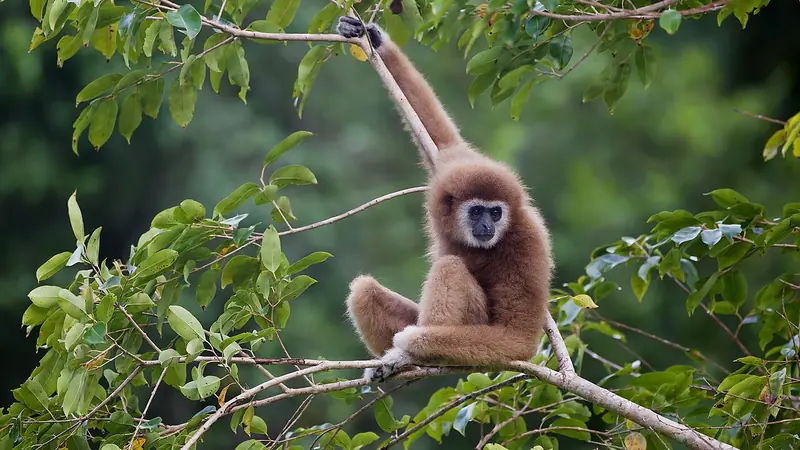
The gibbon house was rebuilt from scratch in 2013-2015. The white-handed gibbons Maya, Samuk and Yuki swing hand over hand from branch to branch at around 50 kilometres an hour and can fly through the air for more than 10 metres. When they start singing their duet, you can hardly miss it: this is how they warn other gibbons not to enter their territory. Look up, too, because from the gibbon enclosure you can see the steep rock face of the Hellbrunner Berg.

Vulture SlopePhoto User:MatthiasKabel, CC BY-SA 3.0, Wikimedia Commons8
Animals

Vulture Slope

Opposite the binturongs, the slope climbs all the way up to the rocks of the Hellbrunner Berg. On this Vulture Slope (Geierhang) there is a buffet for griffon vultures that fly free: their colony was founded here in 1966 by Heinrich Windischbauer. Today 3 free-flying vultures come here regularly, and in 2022 an enclosure opened here for vultures that cannot fly. In the summer of 2024, 6 females arrived from southern Spain, and the wingspan of a griffon vulture is about 2.8 metres.

Lowland tapirsPhoto Giles Laurent, CC BY-SA 4.0, Wikimedia Commons9
Animals

Lowland tapirs

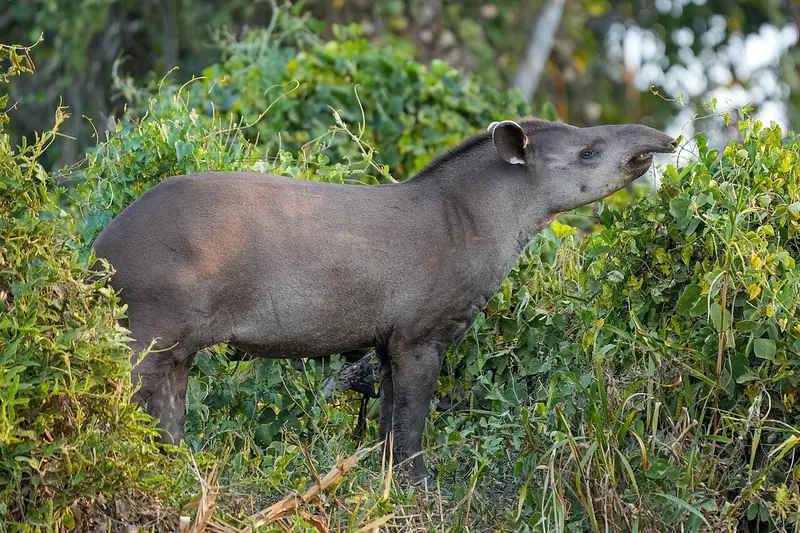
Lowland tapirs, such as Nola and Miguel, have lived at the zoo since 2011, and the zoo takes part in the European breeding programme for them. Tapirs belong to one of the oldest mammal families still alive: they have existed for 50 million years, and their closest relatives are rhinos and horses. They are excellent swimmers and divers, run at up to 35 kilometres an hour, and grab their food with a nimble snout.

JaguarsPhoto Manfred Werner - Tsui, CC BY-SA 3.0, Wikimedia Commons10
Animals

Jaguars

The jaguar house and the South American predator enclosures were renovated in 2013, and boas and caimans also live in the jaguar house. The jaguars Lucky Limari, Maira and Morena have a bite so strong that they can crack the shell of a large turtle, and they are superb swimmers. Black jaguars are called panthers, but even on their fur you can see the characteristic spots.

Snow leopardsPhoto Matthias Süßen, CC BY-SA 4.0, Wikimedia Commons11
Animals

Snow leopards

Snow leopards, also known as irbis, live in the row of former predator enclosures, right next to the puma. Locals in Central Asia call them ghosts of the mountains. They live at altitudes of 2700-5000 metres and can survive frosts down to minus 40 degrees. Their very long tail helps them keep their balance when leaping as far as 15 metres, and when they sleep they wrap it around themselves like a scarf.

White rhinosPhoto Kre Stefan, CC BY-SA 4.0, Wikimedia Commons12
Animals

White rhinos

The white rhino savannah covers more than a hectare and is the largest enclosure in the zoo. Among those living here are the bull Athos, as well as Tamu, Yeti and Zawadi. The white rhino eats only grass, males weigh up to 3500 kilograms, and the animals can live as long as 44 years. Ring-tailed lemurs and banded mongooses also live in the rhino house.

LionsPhoto Michael J. Litzinger, CC BY-SA 4.0, Wikimedia Commons13
Animals

Lions

The lion house opened in 2010: it is low-built, and from it you can see the lion enclosure and the savannah. A pair of northern lions, Kiano and Dara, live here. Northern lions often have a darker mane that extends onto the shoulders and belly. They are the only cats that live in prides, and not only males can roar, but females too.

African penguinsPhoto Marcin Konsek, CC BY-SA 4.0, Wikimedia Commons14
Animals

African penguins

The 300 square metre penguin enclosure was built in 2019-2020 to the north of the rhino enclosure, for 1.3 million euros. The African penguin is the only penguin living in Africa, and it owes its German name, meaning spectacled penguin, to the pink patches of skin around its eyes, which help it keep cool. The best-known colony is on Boulders Beach near Cape Town. The number of these penguins has fallen by as much as 97 percent in recent decades, and the species is critically endangered.

Zebras and antelopesPhoto Gzen92, CC BY-SA 4.0, Wikimedia Commons15
Animals

Zebras and antelopes

On the savannah, Grévy's zebras, scimitar-horned oryx and lechwe graze alongside the rhinos. Grévy's zebra is the largest and one of the rarest zebras: only around 2000 adults are left in the wild. It owes its name to the French President Jules Grévy, who in 1882 was given such a zebra as a gift from the Emperor of Abyssinia. Unlike other zebras, it lives alone and does not form permanent herds.

CheetahsPhoto User:MatthiasKabel, CC BY-SA 2.5, Wikimedia Commons16
Animals

Cheetahs

Salzburg Zoo became famous for its cheetah enclosure with a prey simulator that raced along at 60 kilometres an hour, but the device has not worked for a long time. Among those living here are the cheetahs Aeris and Bia. A cheetah stands up to 94 centimetres at the shoulder, weighs up to 65 kilograms and hunts smaller hoofed animals, such as gazelles. This is the end of the route: from here the main avenue takes you back to the exit.

All points (23)

Grouped as in the map legend. A star marks recommended points.

Animals 18
Alpine ibex ★The Alpine ibex are number 1 on the zoo map, beside the Steinbock ticket office, which you enter from the Hellbrunn Palace park side. Males weigh up to 100 kilograms, females up to 40, and they live for 15-18 years. They eat the grasses and herbs of Alpine meadows, but are also happy to nibble shrubs and tree shoots. In 2012 the enclosure was rebuilt so that you can watch the animals up close.
Wolverines ★Below the steep slope of the Hellbrunner Berg lives a pair of wolverines, Järvi and Logan. The wolverine belongs to the weasel family, stands up to 45 centimetres at the shoulder and weighs up to 30 kilograms. It lives in the taiga and tundra around the North Pole. In summer it mainly eats carrion, eggs and berries, and in winter it hunts mountain hares, mice and ptarmigan, sometimes even reindeer and young elk.
Brown bears ★The brown bear enclosure opened in 1990 on the slope of the Hellbrunner Berg, and among those living here is Losa. Although bears are carnivores, they mainly eat plants, and only occasionally fish, meat or carrion. Males can weigh as much as 550 kilograms, yet they run fast and swim well. In winter, here in the zoo too, the bears go to sleep for several months, so you may not see them then.
Petting zoo ★The Arche enclosure is home mainly to rare, endangered breeds of farm animals, including pygmy goats, mini pigs, chickens and Japanese quail. You can stroke the animals here, but you may only feed them with special food bought at the zoo ticket office. Next to it runs the Bee Trail (Bienenweg), where honeybees live.
Red pandas ★Next to the zoo shop live the red pandas Haku and Xia. They come from the mountain and bamboo forests of the Himalayas, where they live as high as 4500 metres. They mainly eat bamboo, but also roots, fruit, berries and nuts, and weigh at most 6 kilograms. Their enclosure was rebuilt in 2013-2015, and the red panda is an endangered species.
Arctic wolves ★Arctic wolves, such as Isegrim and Nura, come from northern North America and from Greenland. In the Arctic the temperature drops to minus 60 degrees, and the wind blows at up to 200 kilometres an hour. Thick fur, a compact build and short ears protect them from the cold, and big paws help them walk on ice and snow. The pack sticks together even more closely than in other wolves and usually numbers 7-10 animals.
White-handed gibbons ★The gibbon house was rebuilt from scratch in 2013-2015. The white-handed gibbons Maya, Samuk and Yuki swing hand over hand from branch to branch at around 50 kilometres an hour and can fly through the air for more than 10 metres. When they start singing their duet, you can hardly miss it: this is how they warn other gibbons not to enter their territory. Look up, too, because from the gibbon enclosure you can see the steep rock face of the Hellbrunner Berg.
Vulture Slope ★Opposite the binturongs, the slope climbs all the way up to the rocks of the Hellbrunner Berg. On this Vulture Slope (Geierhang) there is a buffet for griffon vultures that fly free: their colony was founded here in 1966 by Heinrich Windischbauer. Today 3 free-flying vultures come here regularly, and in 2022 an enclosure opened here for vultures that cannot fly. In the summer of 2024, 6 females arrived from southern Spain, and the wingspan of a griffon vulture is about 2.8 metres.
Lowland tapirs ★Lowland tapirs, such as Nola and Miguel, have lived at the zoo since 2011, and the zoo takes part in the European breeding programme for them. Tapirs belong to one of the oldest mammal families still alive: they have existed for 50 million years, and their closest relatives are rhinos and horses. They are excellent swimmers and divers, run at up to 35 kilometres an hour, and grab their food with a nimble snout.
Jaguars ★The jaguar house and the South American predator enclosures were renovated in 2013, and boas and caimans also live in the jaguar house. The jaguars Lucky Limari, Maira and Morena have a bite so strong that they can crack the shell of a large turtle, and they are superb swimmers. Black jaguars are called panthers, but even on their fur you can see the characteristic spots.
Snow leopards ★Snow leopards, also known as irbis, live in the row of former predator enclosures, right next to the puma. Locals in Central Asia call them ghosts of the mountains. They live at altitudes of 2700-5000 metres and can survive frosts down to minus 40 degrees. Their very long tail helps them keep their balance when leaping as far as 15 metres, and when they sleep they wrap it around themselves like a scarf.
White rhinos ★The white rhino savannah covers more than a hectare and is the largest enclosure in the zoo. Among those living here are the bull Athos, as well as Tamu, Yeti and Zawadi. The white rhino eats only grass, males weigh up to 3500 kilograms, and the animals can live as long as 44 years. Ring-tailed lemurs and banded mongooses also live in the rhino house.
Lions ★The lion house opened in 2010: it is low-built, and from it you can see the lion enclosure and the savannah. A pair of northern lions, Kiano and Dara, live here. Northern lions often have a darker mane that extends onto the shoulders and belly. They are the only cats that live in prides, and not only males can roar, but females too.
African penguins ★The 300 square metre penguin enclosure was built in 2019-2020 to the north of the rhino enclosure, for 1.3 million euros. The African penguin is the only penguin living in Africa, and it owes its German name, meaning spectacled penguin, to the pink patches of skin around its eyes, which help it keep cool. The best-known colony is on Boulders Beach near Cape Town. The number of these penguins has fallen by as much as 97 percent in recent decades, and the species is critically endangered.
Zebras and antelopes ★On the savannah, Grévy's zebras, scimitar-horned oryx and lechwe graze alongside the rhinos. Grévy's zebra is the largest and one of the rarest zebras: only around 2000 adults are left in the wild. It owes its name to the French President Jules Grévy, who in 1882 was given such a zebra as a gift from the Emperor of Abyssinia. Unlike other zebras, it lives alone and does not form permanent herds.
Cheetahs ★Salzburg Zoo became famous for its cheetah enclosure with a prey simulator that raced along at 60 kilometres an hour, but the device has not worked for a long time. Among those living here are the cheetahs Aeris and Bia. A cheetah stands up to 94 centimetres at the shoulder, weighs up to 65 kilograms and hunts smaller hoofed animals, such as gazelles. This is the end of the route: from here the main avenue takes you back to the exit.
Forest reindeerForest reindeer come from Finland and Russian Karelia, where they live in the taiga. They stand up to 1.4 metres at the shoulder, and males weigh 100-180 kilograms. They eat buds, grass, herbs, mushrooms and lichens. In human care they can live as long as 20 years, but in the wild rarely more than 6, and they are a vulnerable species.
Greater flamingosGreater flamingos nest in tropical Africa, by the Caspian Sea, in India and Pakistan. They live on salt lakes and shallow lagoons, where they fish out small crustaceans, mosquito larvae, molluscs, worms and algae. Their wingspan is 140-165 centimetres, and they can live as long as 40 years.
Toilets / tickets / parking 5
Main ticket officeYour visit begins at the main ticket office, a few minutes' walk from the number 25 bus stop. The zoo opened in 1961 in memory of an old game park: from 1612 Archbishop Markus Sittikus built Hellbrunn Palace with a large game park around the Hellbrunner Berg hill. The route first goes north along the main avenue to the ibex, and then back through Eurasia and South America all the way to Africa.
Public toilet
Public toilet
Public toilet
Public toilet
Zoo SalzburgGet Turi